
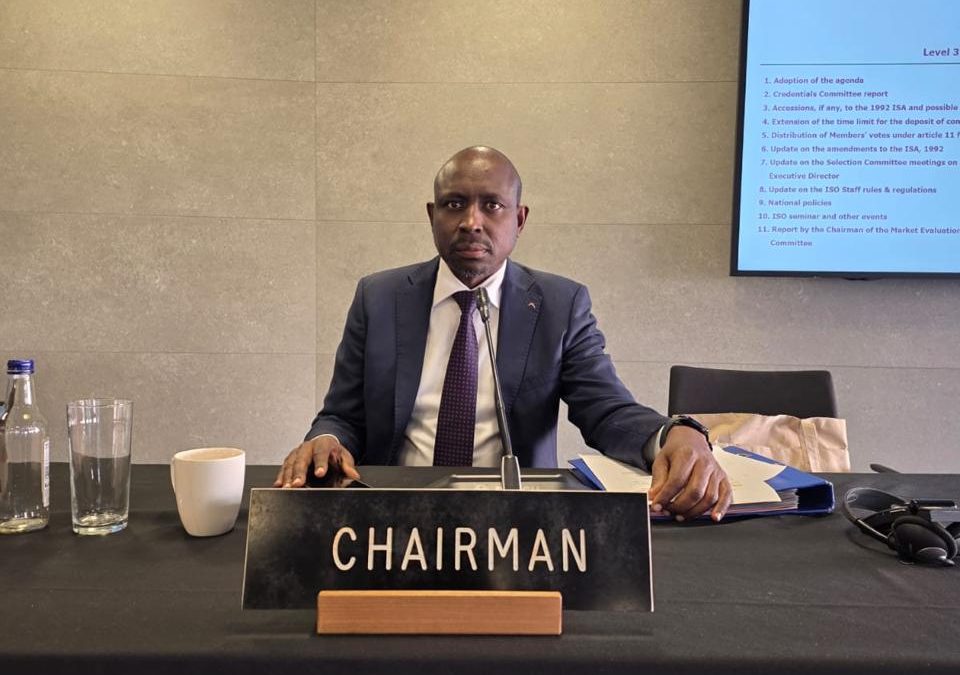
Kenya has scored one of its biggest global wins in decades after Kenya Sugar Board CEO Jude Chesire was unanimously elected Chairman of the Council of the International Sugar Organization (ISO) for 2026—becoming the first Kenyan and the first African to ever hold the top seat of the world’s leading sugar governance body headquartered in London and affiliated to the World Trade Organization (WTO).
Chesire’s election—taking over from Edgar Herrera of Costa Rica—cements Kenya’s arrival on the global sugar stage at a defining moment when the continent is positioning itself as a major producer, exporter, and value-addition hub.
Chesire’s elevation signals international recognition of Kenya’s sweeping sugar sector reforms, which he has personally steered under the leadership of Agriculture and Livestock Development Cabinet Secretary Sen. Mutahi Kagwe.
Under these reforms:
- Four state-owned sugar mills—Sony, Muhoroni, Chemelil, Nzoia—have been leased to private operators, unlocking long-awaited efficiency and investment.
- 47,123 hectares of new cane have been established.
- Sugar production has jumped by 76%, reversing nearly two decades of decline.
- Cane prices have risen from KES 4,350 to KES 5,750 per tonne, restoring farmer dignity.
- The sector now supports 250,000 direct jobs and nearly 6 million livelihoods.
These achievements—highlighted under the Bottom-Up Economic Transformation Agenda (BETA)—have drawn global admiration and placed Kenya as a case study for successful agricultural reform.
As Chairman of the world’s premier sugar organization, Chesire will hold direct responsibility for:
- Recruiting a New Executive Director & CEO
He will guide the global process to replace Jose Orive (Guatemala), whose 13-year tenure ends in December 2026.
- Steering the Rewrite of the ISO Constitution
A major overhaul of the organization’s governance structure is underway, and Chesire will preside over these historic reforms.
- Shaping Global Sugar Trade Policy
From price stabilization to trade barriers, carbon credits, bioethanol, and sustainability standards, Kenya will finally sit at the head of the table.
- Expanding Africa’s Voice in Global Commodity Markets
His election—together with Ambassador Ali Touré of Ivory Coast, who was unanimously elected Vice Chairman—marks the strongest African bloc representation in ISO history.
Chesire’s leadership positions Kenya to:
1.Secure better global market terms for its sugar.
2.Attract international investors into milling, cogeneration, ethanol, and value-addition.
3.Accelerate Kenya’s journey toward sugar self-sufficiency by 2027.
4.Influence global policies affecting tariffs, standards, and market access.
5.Strengthen the credibility of Kenya’s sugar reforms, reassuring farmers and private millers.
6.This is more than a personal achievement—it signifies that Kenya’s agricultural governance is earning global respect, reinforcing the Ministry’s aggressive push to modernize and commercialize the sector.
As Kenya continues revitalizing the sugar industry—backed by private-sector investment, digital traceability, better seeds, improved research, and farmer-centered policies—Chesire’s chairmanship gives the country a strategic advantage at a time when sugar remains one of the world’s most traded commodities.
His election affirms that Kenya is no longer just a participant in global agriculture—it is now a leader shaping the future of the sector.